Houston Chronicle: Homeless advocates focus on results, not just effort
Communications Admin • July 8, 2013
Federal funding now goes to those programs that can show results
By Jayme Fraser
Programs serving the homeless used to get federal funding just by showing how they will help people living on the street.
Now, they must prove they are actually making a difference.
The new results-focused approach extending from the U.S. Department of Housing and Urban Development gives local leaders more say in how to divvy up federal funds and more responsibility for making sure it works.
In the past, federal authorities awarded grants primarily based on how well individual programs served their target populations. Under the new rules, federal officials also will consider where each program fits in the community network of services to avoid duplications.
“It’s no longer about meeting a minimum threshold to receive your money,” said Mandy Chapman-Semple, the mayor’s special assistant on homeless initiatives. “Rather, they’ll evaluate the impact they’re having as part of our system. Are they contributing enough?”
The policy change reflects a goal President Barack Obama announced in 2010 to end chronic and veteran homelessness by 2015, as well as a shrinking federal budget that has programs looking at improving efficiency.
In May, federal housing representatives told a gathering of advocates that the Houston area appears to have too many transitional housing units – apartments or rooms provided to the homeless for a limited time while they try to find permanent homes. The review of 2012 data from hundreds of metro-area providers found that only 71 percent of transitional housing units were occupied full-time, in effect spending up to $4 million on empty rooms. Additionally, only 45 percent of clients left transitional housing for a permanent home.
The report suggested that about 15 percent of the area’s more than 5,000 transitional units could be converted to permanent supportive housing.
Tracked by evidence
The transitional housing approach to reducing homelessness has lost widespread support after some studies have shown it has a limited ability to keep people off the streets. Case managers say the time limits on transitional housing are unrealistic for some clients, particularly those who have been homeless several times in the previous three years and who often face complicating health issues.
The “housing first” model, or permanent supportive housing, provides health and other recovery services after a client has a stable home with no time limits. It has seen growing national support, including among federal authorities, because it does not remove clients from programs before they are truly self-sufficient.
Cheraline Canida, 39, a recovering drug and alcohol addict working through a Harmony House program, said an opportunity to rebuild without rushing her sobriety makes her more hopeful she will succeed. In the past, she has relapsed.
“Addiction takes everything from you,” Canida said. “Here I can work and get the things I will need to one day have my own place.”
The Coalition for the Homeless, the action arm of the local governing board, is speaking with each area program about its performance and where it fits – or could fit – in the system.
“Let’s really track them by the evidence,” said Marilyn Brown, coalition president. “Who are the high performers and how do they do it? Which programs might need more training and technical assistance?”
She and Chapman-Semple hope those discussions will identify volunteers willing to convert transitional housing into permanent supportive housing.
Expanded program
Harmony House was among the first to go through a review with the Coalition.
The nonprofit started assisting homeless men 20 years ago, but since has expanded to a variety of services, including monitoring and providing beds to homeless persons discharged from area hospitals after surgery. Two other programs target people recovering from addictions.
Following the review, the medical program will remain a transitional service since its goal is health and not housing. The addiction recovery program, however, will be converted to permanent supportive housing so they can ensure clients leave when ready, not just when a deadline approaches.
Harmony House CEO Tim Johnson said the federal analysis has confirmed what many say they already suspected, but had no way to systematically address or even discuss.
“We weren’t open enough to see where we were focusing too much on one thing,” Johnson said, referring to the abundance of transitional units in Houston.
More collaboration
Preston Witt, Harmony House’s social services director, lauded the new system-wide approach as a way to better serve the homeless while increasing collaboration between providers. He remains nervous, though.
He wonders how the stark changes to federal regulation will affect competition among some programs for funding, particularly with the focus on shrinking transitional housing that has dominated the Houston approach for years. Historically, many homeless programs remained isolated or limited collaborations to a few close partners since they were competing for federal funds.
“You protect your own dollars,” Witt said. “The complete idea is to be collaborative, but I don’t think it’s fully implemented yet.”
Brown said the coalition and the governing board, which must lead the transition, are aware that realigning all Houston-area programs by 2015 is a tough task that has made some as nervous as they are excited about what it means for their future.
“Nobody leaps onto change,” Brown said. “Even when it’s good.”
To read the entire article on the Houston Chronicle, click here.
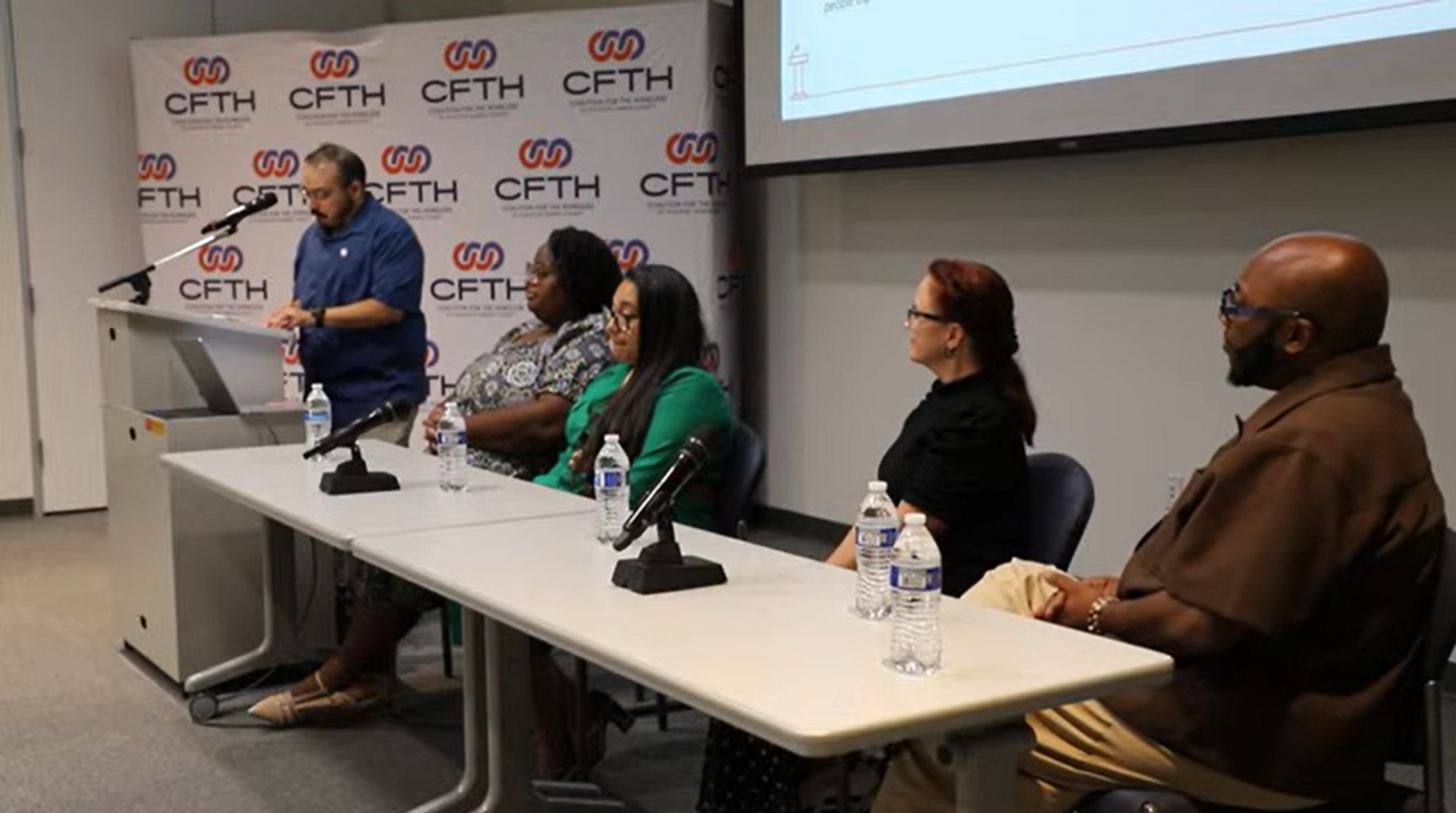
When someone experiences homelessness, the right solution is not always a long-term housing program. Sometimes a person needs help replacing an ID, reconnecting with family, finding an affordable shared home or overcoming another immediate barrier. That idea guided CFTH Presents: Building Better Pathways — Creating Faster Routes to Stability . The Coalition for the Homeless of Houston/Harris County (CFTH) hosted the discussion with leaders who oversee and carry out Rapid Resolutions across The Way Home, the Houston region’s homeless response system.

When most people think about homelessness, they picture someone sleeping outside or staying in a shelter. But homelessness often begins much earlier. A new survey from Rice University's Kinder Institute estimates that more than 140,000 adults across Harris, Fort Bend and Montgomery counties experienced temporary homelessness during the past year. Many of these individuals never slept outside. They stayed with friends or family because they had nowhere else to go, paid for motel rooms when they could, slept in their vehicles or found other temporary ways to get by. For those of us working in Houston's homeless response system, the estimate did not come as a surprise. What stands out is the scale. Our 2026 State of Homelessness report found that nearly 36,000 people interacted with The Way Home, Houston's regional homeless response system, during 2025. The Kinder estimate shows a much larger group of households struggling before they ever reach organizations like ours. Those numbers do not compete with one another. They tell the story of different points along the same continuum. By the time someone decides whether to enter a shelter or sleep outside, opportunities to prevent homelessness have often passed. The homeless response system helps people regain stability after they are in a shelter or on the street. Prevention happens months earlier, while people are still trying to hold on to their housing. Most people do not ask for help at the first sign of trouble. They work extra hours. They borrow money from family. They juggle bills. They hope next month's paycheck will solve this month's problem. Like most of us would, they try to solve the problem themselves. By the time they reach out, they often need far more help than they would have needed just a few months earlier. That is why Houston's prevention network is so important. Organizations like United Way of Greater Houston connect residents with rental assistance, utility assistance, benefits navigation and other resources that help stabilize households before they lose their housing. If you are struggling to keep up with rent, utilities or other essential expenses, do not wait until you have exhausted every option. Reaching out early gives providers more opportunities to help and gives families more options to stay housed. The Kinder research also reinforces another reality facing our region: We need more affordable housing. More than 140,000 adults experienced temporary homelessness in a single year because too many households live one unexpected expense away from losing their housing. That number points to a much larger population searching for homes they can afford long before they need homeless services. Houston's homeless response system continues to produce strong outcomes. More than 2,100 households moved into permanent housing during 2025, and 85% of those who exited homelessness two years ago remain housed today. At the same time, more than 7,100 people slept in shelters or on the street for the first time in 2025. Those numbers show that while our homeless response system continues to help thousands of people regain stability, new households continue to enter homelessness every day. The Kinder research gives Houston something we have not had before: a clearer picture of the households struggling before homelessness becomes visible. The Way Home will always play a critical role in helping people regain stability, but we also need to help more people before they ever need those services. That means strengthening prevention programs, expanding affordable housing and making it easier for people to ask for help early. Houston has repeatedly shown that when our community understands a challenge, it comes together to solve it. This research gives us a better understanding of where the next challenge begins.

Extreme Heat Is America's Deadliest Weather Hazard. Find Trusted Resources to Stay Safe and Help Others.