
2013 Point-In-Time Count’s New Methodology Explained
Communications Admin • July 8, 2013
By Dr. Cathy Troisi, Associate Professor at the University Of Texas School Of Public Health
Several significant changes were made in the methodology of the 2011 count to improve the completeness and accuracy of the enumeration and these were implemented and enhanced in the 2012 and 2013 counts as well. The first was the involvement of traditional homeless services providers under the umbrella of the Coalition for the Homeless along with academia (University of Texas Health Science Center at Houston School of Public Health) and a local health department [Houston Department of Health and Human Services (HDHHS)].
This collaboration was exemplified by including the implementation of an Incident Command System (ICS), a standardized management tool used in fire, police, and public health preparedness activities ensuring integration of efforts through its defined organizational structure. ICS has many advantages including an orderly, systematic planning process and clear chains of command and supervision. Command Central was set up at HDHHS.
Other improvements in 2013 included use of ten staging areas, an increase of four over the six staging areas used in 2010 and one over the nine used in 2011 and 2012. The additional staging areas reduced travel time needed by teams to get into the field and thus increased their time available to count the homeless. One practice count took place on January 22th before the actual count on January 29th. This allowed Staging Area Captains and Co-Captains as well as the Surface and Outreach Specialist teams to become familiar with their duties and the geographic areas which they were to cover.
Enumeration activity included the Ft. Bend area to better characterize homelessness in that county. Efforts in the past to count Ft. Bend homeless individuals have not been optimized and so the extent of the problem has not been well defined. By increasing the number of teams and adding a staging area in the county, we were able to get a better picture of homelessness in that area.
Improvements were made to the composition and function of teams that counted the unsheltered homeless. Volunteer teams included homeless and formerly homeless individuals who could guide teams to locations where the homeless are likely to be found. The use of Outreach Specialist Teams to canvass areas not readily seen by teams driving by resulted in fewer unsheltered homeless remaining undetected. On the night of the count, “SWAT” teams were formed with HDHHS personnel. These teams were sent out to sectors that needed additional assistance identifying and counting homeless persons, thus increasing coverage of all areas.
The methodology of the sheltered count also was enhanced. This was accomplished in two ways. First, a greater effort was made to identify and inventory all emergency shelters in the area, whether or not they were officially part of the Houston/Harris County Continuum of Care. Secondly, shelters that use the housing inventory chart were encouraged to return that form for the night of the PIT and follow-up calls were made to ensure they were received. For 2010, 75% of the emergency shelter projects and 69% of the transitional housing projects reported the number of persons sheltered on the night of the PIT. For the 2011-2013 counts, due to this increased effort, 100% of entities defined by HUD as housing the sheltered homeless for the purposes of the Point-in-Time count (n=65) reported their numbers. Over 94% of sheltered numbers came from HMIS, meeting the HUD requirement of >75%.
The 2013 PIT Count included a concerted effort to enumerate emancipated youth ages 24 and younger who have not been optimally counted in previous years entitled YouthCount!. This was done by sending volunteer teams to places where youth were known to congregate and administering a short survey to collect basic demographic information as well as length and reasons for homelessness. Places canvassed included Ft. Bend Women’s Center, HAY Center, Star of Hope, Salvation Army Social Services, Covenant House, Open Gate Bering UMC Youth Advocates, Kinder Emergency Shelter, Houston Area Women’s Center, and Montrose Grace Place.
A point-in-time (PIT) count of sheltered and unsheltered homeless persons in the Houston, Harris County, and Ft. Bend County areas was conducted from 3 to 11 pm on 29 January 2013. The purpose of the count was to determine the number of homeless persons [defined by the Department of Housing and Urban Development (HUD) as those staying in emergency shelter, transitional housing, or safe haven with beds dedicated for homeless persons or those persons who are unsheltered (i.e., staying in a place not meant for human habitation)]. The PIT count is a federal requirement for all communities receiving funding from HUD. Although, due to the size of the geographic area that is covered by the count, we know that not all persons experiencing homelessness can be identified in a single night, the PIT Count gives a good assessment of the extent of the problem in the region.
The PIT count was organized and led by the Coalition for the Homeless in consultation with The University of Texas School of Public Health and the Houston Department of Health and Human Services. Many homeless services providers participated as well as community volunteers, including homeless and formerly homeless persons.
The 2013 count enumerated individuals staying in a total of 65 shelters including emergency shelters (n=16), transitional housing units (n=48), and one safe haven on the night of 29 January based on reports received from the providers. Unsheltered homeless individuals (those sleeping on the streets or in places not meant for habitation) were counted using two methods. Surface teams (one driver, one service provider, one homeless or formerly homeless person, and one community volunteer) drove the streets of the enumeration area observing and counting homeless individuals. Teams left from one of ten staging areas, each of which was divided into smaller sectors. The number of teams assigned to each sector was based on the prevalence of unsheltered homeless in previous counts. The surface teams counted unsheltered homeless persons found on street corners, parks, parking lots, convenience stores and other areas where they congregate.
Areas where homeless persons were likely to be found but that are not visible from the street were canvassed by Outreach Specialist Teams comprised of homeless service providers familiar with the areas through their professional work. These teams walked under bridges, along the bayous and other areas where encampments of homeless had been identified. They also investigated abandoned buildings where homeless persons may be residing. Care was taken not to double count homeless individuals.
To read the Executive Summary of the findings from the 2013 Point-in-Time Count, click here.
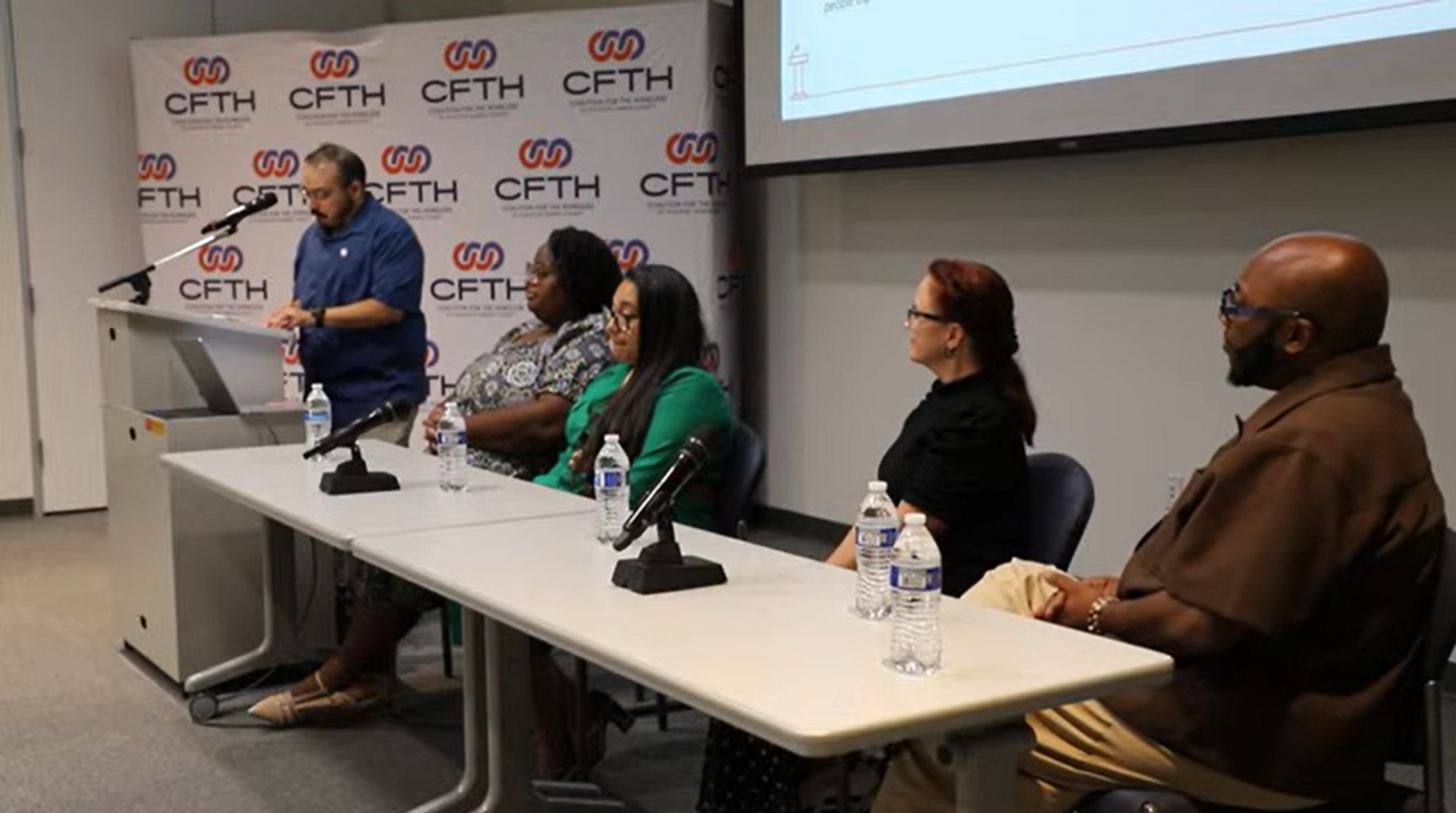
When someone experiences homelessness, the right solution is not always a long-term housing program. Sometimes a person needs help replacing an ID, reconnecting with family, finding an affordable shared home or overcoming another immediate barrier. That idea guided CFTH Presents: Building Better Pathways — Creating Faster Routes to Stability . The Coalition for the Homeless of Houston/Harris County (CFTH) hosted the discussion with leaders who oversee and carry out Rapid Resolutions across The Way Home, the Houston region’s homeless response system.

When most people think about homelessness, they picture someone sleeping outside or staying in a shelter. But homelessness often begins much earlier. A new survey from Rice University's Kinder Institute estimates that more than 140,000 adults across Harris, Fort Bend and Montgomery counties experienced temporary homelessness during the past year. Many of these individuals never slept outside. They stayed with friends or family because they had nowhere else to go, paid for motel rooms when they could, slept in their vehicles or found other temporary ways to get by. For those of us working in Houston's homeless response system, the estimate did not come as a surprise. What stands out is the scale. Our 2026 State of Homelessness report found that nearly 36,000 people interacted with The Way Home, Houston's regional homeless response system, during 2025. The Kinder estimate shows a much larger group of households struggling before they ever reach organizations like ours. Those numbers do not compete with one another. They tell the story of different points along the same continuum. By the time someone decides whether to enter a shelter or sleep outside, opportunities to prevent homelessness have often passed. The homeless response system helps people regain stability after they are in a shelter or on the street. Prevention happens months earlier, while people are still trying to hold on to their housing. Most people do not ask for help at the first sign of trouble. They work extra hours. They borrow money from family. They juggle bills. They hope next month's paycheck will solve this month's problem. Like most of us would, they try to solve the problem themselves. By the time they reach out, they often need far more help than they would have needed just a few months earlier. That is why Houston's prevention network is so important. Organizations like United Way of Greater Houston connect residents with rental assistance, utility assistance, benefits navigation and other resources that help stabilize households before they lose their housing. If you are struggling to keep up with rent, utilities or other essential expenses, do not wait until you have exhausted every option. Reaching out early gives providers more opportunities to help and gives families more options to stay housed. The Kinder research also reinforces another reality facing our region: We need more affordable housing. More than 140,000 adults experienced temporary homelessness in a single year because too many households live one unexpected expense away from losing their housing. That number points to a much larger population searching for homes they can afford long before they need homeless services. Houston's homeless response system continues to produce strong outcomes. More than 2,100 households moved into permanent housing during 2025, and 85% of those who exited homelessness two years ago remain housed today. At the same time, more than 7,100 people slept in shelters or on the street for the first time in 2025. Those numbers show that while our homeless response system continues to help thousands of people regain stability, new households continue to enter homelessness every day. The Kinder research gives Houston something we have not had before: a clearer picture of the households struggling before homelessness becomes visible. The Way Home will always play a critical role in helping people regain stability, but we also need to help more people before they ever need those services. That means strengthening prevention programs, expanding affordable housing and making it easier for people to ask for help early. Houston has repeatedly shown that when our community understands a challenge, it comes together to solve it. This research gives us a better understanding of where the next challenge begins.

Extreme Heat Is America's Deadliest Weather Hazard. Find Trusted Resources to Stay Safe and Help Others.