Homelessness 101: Street Guide v. Help Card
Communications Admin • October 26, 2018
Two critical resources offered by the Coalition for the Homeless to those who need help are the Street Guide
and the Help Card. These two resources are similar in that they both offer information on local assistance programs; however, the Street Guide is meant act as a primary resource to those experiencing a literal homelessness crisis, and the Help Card should be used as a secondary resource by people once in a shelter or housing program, or even by case managers looking to connect their clients with support services.
The Street Guide
was created in collaboration with Rice University’s Design for America program
in 2015. Rice DFA approached the Coalition about creating an easy to use and maintain resource that would provide the most critical information to people facing a homelessness crisis. The result was a simple printed document that is just a single page front and back, but has a wealth of information on local homeless assistance programs that includes addresses, hours of operation, and even nearby METRO routes. Every program listed on the Street Guide is connected to Coordinated Access and has assessors on-site to conduct housing assessments with those experiencing homelessness. Housing assessments help us gather information on a client’s unique situation and make a referral to the right permanent housing program to help end their homelessness.
For those who may not have access to the internet, copies of the Street Guide
can be picked up at the Coalition for the Homeless’ offices, just call ahead first so we can be sure to print the most recent and up-to-date copy of the guide. Many partner agencies also print Street Guides and keep them in their offices and lobbies.
The Street Guide is often handed out by street outreach partners of The Way Home, if someone experiencing unsheltered homelessness doesn’t want to seek shelter right then and there, the outreach teams can leave a street guide with the individual in case they want to seek services later. Community members can also print and keep copies of the Street Guide
on hand in their vehicles or bags, to hand out to those they see who may be experiencing homelessness out and about in the Houston region, as long as they feel safe doing so.
The Coalition’s other resource, the Help Card, is more robust resource with less critical – but still important! – resources. The Help Card is a tool that can be utilized not only by formerly homeless individuals, but case managers, partner agencies, and even the public.
The Help Card
has a unique background and was first created by students volunteering at HOMES clinic
after they found themselves searching for the same resources over and over again. They first published their work in resource book format in 2002 as a fundraiser for their organization. Healthcare for the Homeless of Houston(HHH), a parent organization of HOMES Clinic, eventually took over the project and created a services card that was then passed on to the Coalition. From there, the Coalition was able to transform the services card into what is now known today as the Help Card. The original format was a single page, front and back, with contact information of wide variety of homeless service providers in our community.
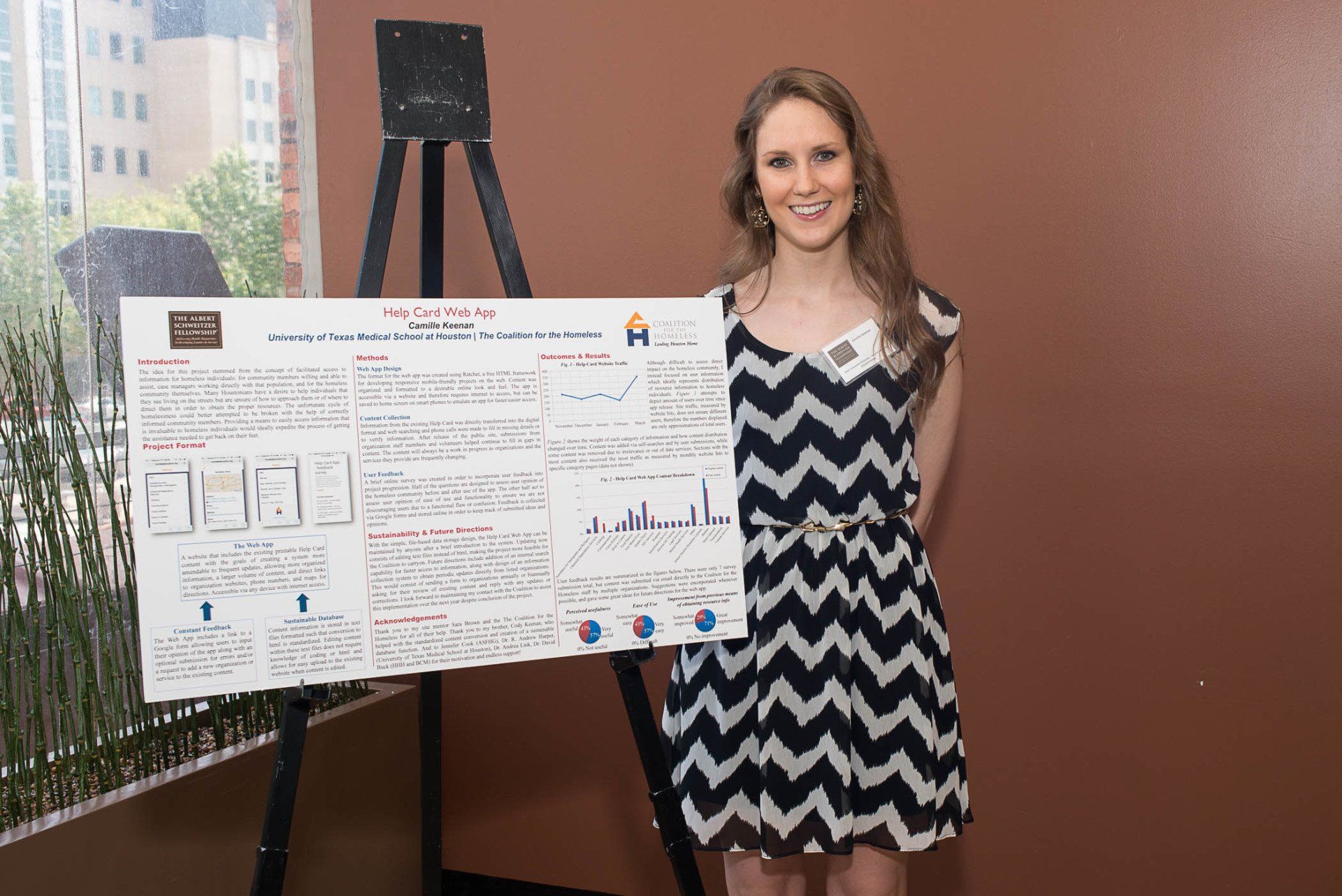
Because of the evolution of technology and the constantly changing information in the homeless service system, the Help Card was put into a digital format for more efficient use which would allow information to updated as needed. This also created an opportunity for the Coalition to increase the amount of information contained in the Help Card and create a more streamlined process for keeping the resources up-to-date. This integration was a collaboration between the Coalition and UT Houston Medical Student, Camille Keenan. Camille approached the Coalition independently about a way to digitize the Help Card. She also independently applied for and received an Albert Schweitzer Fellowship grant to be able to complete the project. Even though Camille is now doing her medical residency in the Dallas area, she is still always on standby and willing to help the Coalition keep the Help Card up-to-date!
Case managers, social workers, and nonprofit employees can use the Help Card to provide those experiencing homelessness with up-to-date information about the resources that are available to them. Help Card resources can be tailored to a specific individual and what their needs are at the time. Community members can also use the Help Card as a way to learn more about the homelessness in our area and find out how to get involved with one of The Way Home’s direct service partner agencies.
The Help Card
lives on the Coalition website. The Help Card is searchable by zip code and there is a wide variety of categories featured on the Help Card such as Drop-In Centers, Hospitals, Clothing, Income/Job Training, just to name a few. Each category then has a sub-category that lists the names of organizations who provide that specific resource. Once you click on the name of the organization, the Help Card lists the phone number, website and short About section to learn more. The Street Guide can also be accessed through the Help Card.
Both the Help Card and Street Guide are essential resources utilized by the Coalition and partner agencies of The Way Home. While the Street Guide is used for those experiencing literal homelessness, the Help Card has a multi-functional use and is essential for those who have recently been placed into a program and are looking for additional resources. To access either the Street Guide or the Help Card, click here.

Extreme Heat Is America's Deadliest Weather Hazard. Find Trusted Resources to Stay Safe and Help Others.
Houston, Texas (June 12, 2026) — The Coalition for the Homeless of Houston/Harris County (CFTH) today released the results of the 2026 Point-in-Time Count & Survey as part of the inaugural State of Homelessness in Houston report, a regional effort that combines PIT Count data with additional system indicators to provide a broader understanding of homelessness and system response across Harris, Fort Bend, and Montgomery counties. The report found 3,321 people experiencing homelessness on a single night in February 2026, reflecting relative stability compared to the 2025 Point-in-Time Count of 3,325. At the same time, the data highlights continued challenges related to unsheltered homelessness, economic and housing pressures, and the ongoing need for coordinated regional investment in homeless response and prevention efforts. This year’s report expands beyond the annual Point-in-Time (PIT) Count to include additional indicators generated through the Homeless Management Information System (HMIS) and HUD System Performance Measures (SPMs). Together, these measures provide additional context about year-round interactions with the homeless response system, housing stability outcomes, and inflow into homelessness over time. "The Point-in-Time Count is like a photograph," said Renee Cavazos-Benavides, vice president of the homeless response system at CFTH . "It captures an important moment, but there is always more happening outside the frame. That's why this year's report includes additional indicators that help us understand how people move into homelessness, how they move back into housing, and where we need to focus our efforts as a community." Key findings from the report include: 3,321 people experiencing homelessness during the February 2026 PIT Count 35,988 unique clients served through the homeless response system, The Way Home, during calendar year 2025 2,135 households housed by partners of The Way Home during calendar year 2025 7,110 people entering homelessness for the first time during federal FY25 85% of people who exited homelessness remained stably housed over a two-year period The PIT Count found 2,051 sheltered individuals and 1,270 unsheltered individuals across Harris, Fort Bend, and Montgomery counties. "The additional data shows our system is doing a great job maintaining our progress, in spite of additional economic stressors and pandemic funding having been exhausted,” said Kelly Young, president and CEO of CFTH . “Further progress will depend not only on additional investments in housing and services but also on our ability to expand new interventions to resolve homelessness more quickly." More than half of unsheltered individuals identified during the PIT Count had a matching HMIS record, reflecting ongoing engagement between outreach teams and people experiencing unsheltered homelessness. The findings underscore the continued need for outreach, additional pathways indoors, and sustained local investment to maintain system stability and respond to changing community needs. “The Point-in-Time Count gives our community a chance to pause and check in with people who may not yet be housed, sheltered, or consistently connected to services,” said Dr. Ben King, clinical assistant professor at the University of Houston Tilman J. Fertitta Family College of Medicine . “It helps us capture information that does not always show up in routine system data — including where people are staying, what barriers they are facing, and what they identify as the causes of their homelessness. Used alongside HMIS data, program performance measures, and community input, the PIT Count remains an important tool to answer questions we wouldn't get to ask otherwise." The annual PIT Count is required by the U.S. Department of Housing and Urban Development (HUD) and helps communities measure trends in homelessness over time. However, the PIT Count does not represent the total number of people who experience homelessness throughout the year. The 2026 State of Homelessness in Houston report combines PIT Count data with other key indicators to provide a more complete picture of homelessness across the region. Behind every number is a person, and a better understanding of homelessness helps communities respond more effectively. "The results remind us that homelessness is one of the most complex challenges facing our city. This is why the 419 Emancipation resource living facility is so important. We will continue working with stakeholders to move people off the streets and provide them with assistance, with the goal of reducing homelessness throughout our community and our neighborhoods," said Mayor John Whitmire. “I’m so proud that Harris County has reduced homelessness by more than 16% between 2018 and 2026, even when most other communities have seen homelessness skyrocket. We’re tackling the issue from both ends: we’re investing in programs to prevent poverty and promote economic mobility, and we’re also prioritizing safe and stable housing for those experiencing homelessness. Our community is only as successful as our most vulnerable residents, and I want to thank the Coalition for the Homeless, The Way Home, and all of our other local partners who have helped turn Harris County into a national model for reducing homelessness,” said Harris County Judge Lina Hidalgo. "The 2026 Point-in-Time Count confirms that our region has remained stable while homelessness has increased in many other parts of the country. However, stability is not enough when over a thousand of our neighbors are still sleeping outside. I’m grateful to the Coalition for the Homeless, The Way Home, outreach teams, law enforcement, service providers, and volunteers for showing that a coordinated local approach can help move people from crisis toward housing,” said Harris County Precinct 2 Commissioner Adrian Garcia . “As a former street cop and sheriff, I know we do not solve homelessness by simply moving people from one place to another. We solve it by treating people with dignity, connecting them to services, and creating real pathways to housing. I remain committed to working with our partners to prevent homelessness, support our veterans and most vulnerable residents, and make homelessness rare, brief, and nonrecurring in Harris County." “Harris County’s stability in the Point‑in‑Time Count stands out against the sharp increase in homelessness seen nationwide since the pandemic,” said Harris County Precinct 4 Commissioner Lesley Briones . “These results reflect years of continued investment in strengthening partnerships and expanding critical services, including two new emergency shelters for survivors of domestic violence. We know there is much more work ahead, and I remain committed to working alongside our partners to prevent and ultimately end homelessness in our community.” “Even with limited new funding and few new programs launched during this reporting period, Houston has remained relatively stable. What this latest data underscores is the need to continue investing in service-connected solutions like 419 Emancipation,” said Mike Nichols, Director of the City of Houston Housing and Community Development Department . “Now that 419 is operational, we are optimistic this triage, transition, and treatment model will help connect more individuals to care, services, and clear pathways toward stability. Behind every number is a real person, and our goal is to ensure more Houstonians are connected to the right support and a stronger path forward.” The full report and methodology appendix are available online here. The executive summary is available online here. The State of Homelessness report is available online here. For more information about the PIT Count and The Way Home homeless response system, visit www.cfthhouston.org. For more information and for results of previous years’ counts, please click here . For photos and B roll of volunteers conducting this year’s PIT Count, click here. ### The Coalition for the Homeless of Houston/Harris County (CFTH) is the backbone of Houston’s solutions to homelessness. It’s a nonprofit organization that uses the power of collective impact to move people experiencing homelessness into housing solutions. Learn more at www.cfthhouston.org . The Way Home is the homeless response system for Houston and Harris, Fort Bend, and Montgomery counties. It’s a public-private partnership — a network of dozens of homeless service providers and other government, philanthropic, and business partners. The Coalition for the Homeless of Houston/Harris County (CFTH), a 501c3, is the designated coordinator of The Way Home.
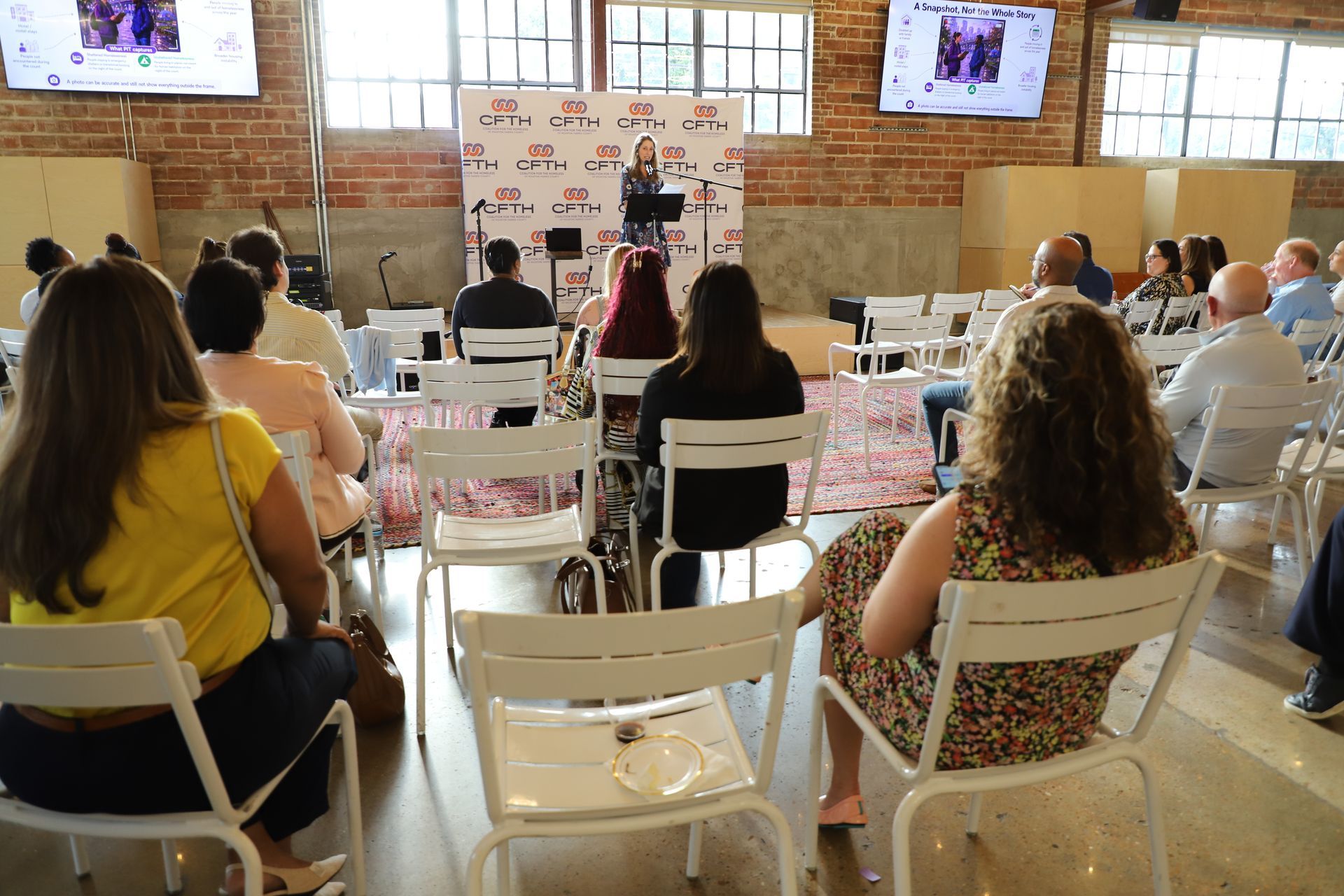
Every year, Houston’s Point-in-Time (PIT) Count helps provide a snapshot of homelessness across the region. But as speakers emphasized during CFTH Presents: The PIT Count — Behind the Numbers , no single number can fully explain homelessness, or the work required to address it. Hosted by the Coalition for the Homeless of Houston/Harris County (CFTH), the discussion brought together leaders from outreach, data systems, and public health to explore how Houston measures homelessness, why the PIT Count matters, and how year-round data helps guide the region’s homelessness response system.