Coalition announces late August Community Charrette, Mayor Parker to Speak
Communications Admin • October 23, 2012
COALITION FOR THE HOMELESS TO HOST COMMUNITY ACTION PLAN MEETINGS, AUGUST 20, 21, 23, 282
August 7, 2012 (Houston, Texas) The Coalition for the Homeless of Houston/Harris County is hosting a four-day Charrette, facilitated by consultants from the Corporation for Supportive Housing (CSH) on August 20-21, 23 and 28.A 15-member Charrette Steering Committee has met over the last three months and through community feedback and information gathering has selected six issue areas to be addressed at the planning sessions. They include: Integrating Housing and Services; Performance and Accountability; Right Sizing the Continuum of Care (CoC) Housing Models; Prevention and Diversion; Coordinated Access and Political Will and Advocacy. Click here for the Charrette flier and Study Guide.
Mayor Annise Parker will give an opening address to Charrette participants on Monday, August 20 at 9:15 a.m. Experts from across the country will speak at the Charrette including: Michael DeVos, United States Interagency Council on Homelessness; Joyce Probst MacAlpine of Montgomery, Ohio; Britt Shawver, Housing Opportunities for Women, Chicago; Mike Shore, Community Solutions, 100,000 Homes Campaign and Kim Walker of the National Alliance to End Homelessness.
“Houston is proud to facilitate this convening of leading experts to help prevent and end homelessness through the development of a Community Action Plan,” said Mayor Annise Parker. “Homelessness is an epidemic in Houston – one that is preventable. I look forward to the recommendations that come out of this planning process.”
The Charrette sessions will be held at the Harris County Department of Education, located at 6300 Irvington Boulevard, Conference Room 502, Houston, 77002. The public is invited to attend these meetings, which will address the causes and propose solutions to the multiple facets of homelessness in the greater Houston area. For information on how to participate in the Charrette, please contact Gary Grier, Director of Community Engagement, Coalition for the Homeless of Houston/Harris County at ggrier@homelesshouston.org
or please call (713) 739-7514.
“Homelessness is a concern for our entire community,” stated Marilyn L. Brown, President and Chief Executive Officer of The Coalition for the Homeless of Houston/Harris County. “The Charrette process is an opportunity for all voices to be heard on this issue. We need to work together to develop an effective action plan to prevent and end homelessness.”
A Charrette is an intensive planning process that jumpstarts and streamlines how a community develops or updates its Community Action Plan. The upcoming Community Charrette on Homelessness, which will encompass Houston, Harris County, and Fort Bend County, is an opportunity for collaboration among diverse stakeholders to solve community problems related to homelessness. The Community Charrette is a direct result of the current Continuum of Care work being led by the Coalition for the Homeless of Houston/Harris County.
CHARETTE SCHEDULE AND TOPICS
Monday, August 20, 2012
9:00 – 9:30 a.m. Welcome and Overview
9:30 – 11:30 a.m. Integrating Housing and Services
12:30 – 2:30 p.m. Performance and Accountability3:00 – 5:00 p.m. Right Sizing CoC Housing Models
Tuesday, August 21, 2012
9:00 – 9:30 a.m. Welcome and Overview
9:30 – 11:30 a.m. Prevention and Diversion
12:30 – 2:30 p.m. Coordinated Access
3:00 – 5:00 p.m. Building Political Will/Advocacy
Thursday, August 23, 2012
10:00 – noon Open office hours for Community Feedback
2:30 – 4:30 p.m. Presentation of Initial Findings/Community Feedback
Session
Tuesday, August 28, 2012
10:00 a.m. – noon Presentation of the Final Report
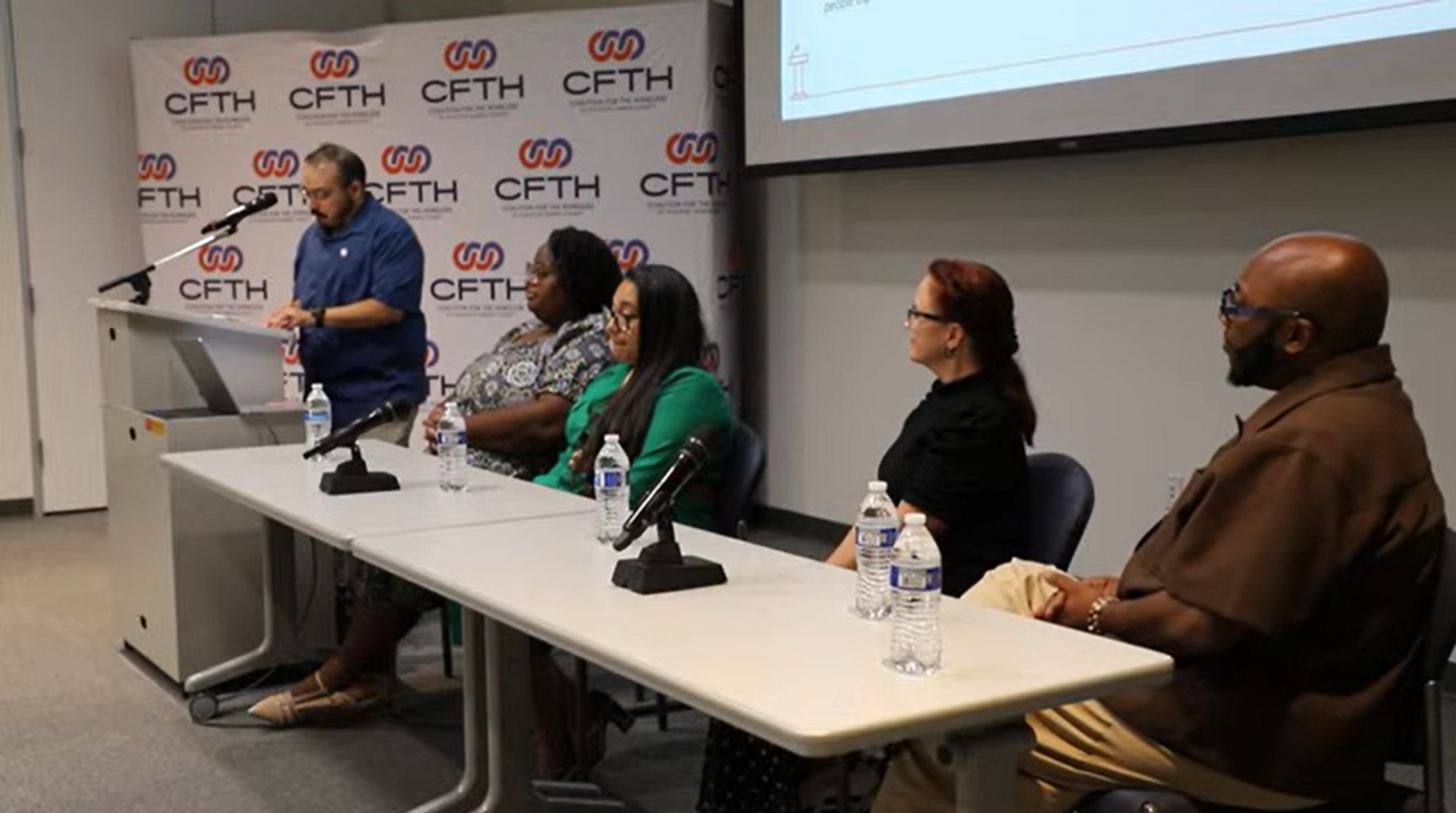
When someone experiences homelessness, the right solution is not always a long-term housing program. Sometimes a person needs help replacing an ID, reconnecting with family, finding an affordable shared home or overcoming another immediate barrier. That idea guided CFTH Presents: Building Better Pathways — Creating Faster Routes to Stability . The Coalition for the Homeless of Houston/Harris County (CFTH) hosted the discussion with leaders who oversee and carry out Rapid Resolutions across The Way Home, the Houston region’s homeless response system.

When most people think about homelessness, they picture someone sleeping outside or staying in a shelter. But homelessness often begins much earlier. A new survey from Rice University's Kinder Institute estimates that more than 140,000 adults across Harris, Fort Bend and Montgomery counties experienced temporary homelessness during the past year. Many of these individuals never slept outside. They stayed with friends or family because they had nowhere else to go, paid for motel rooms when they could, slept in their vehicles or found other temporary ways to get by. For those of us working in Houston's homeless response system, the estimate did not come as a surprise. What stands out is the scale. Our 2026 State of Homelessness report found that nearly 36,000 people interacted with The Way Home, Houston's regional homeless response system, during 2025. The Kinder estimate shows a much larger group of households struggling before they ever reach organizations like ours. Those numbers do not compete with one another. They tell the story of different points along the same continuum. By the time someone decides whether to enter a shelter or sleep outside, opportunities to prevent homelessness have often passed. The homeless response system helps people regain stability after they are in a shelter or on the street. Prevention happens months earlier, while people are still trying to hold on to their housing. Most people do not ask for help at the first sign of trouble. They work extra hours. They borrow money from family. They juggle bills. They hope next month's paycheck will solve this month's problem. Like most of us would, they try to solve the problem themselves. By the time they reach out, they often need far more help than they would have needed just a few months earlier. That is why Houston's prevention network is so important. Organizations like United Way of Greater Houston connect residents with rental assistance, utility assistance, benefits navigation and other resources that help stabilize households before they lose their housing. If you are struggling to keep up with rent, utilities or other essential expenses, do not wait until you have exhausted every option. Reaching out early gives providers more opportunities to help and gives families more options to stay housed. The Kinder research also reinforces another reality facing our region: We need more affordable housing. More than 140,000 adults experienced temporary homelessness in a single year because too many households live one unexpected expense away from losing their housing. That number points to a much larger population searching for homes they can afford long before they need homeless services. Houston's homeless response system continues to produce strong outcomes. More than 2,100 households moved into permanent housing during 2025, and 85% of those who exited homelessness two years ago remain housed today. At the same time, more than 7,100 people slept in shelters or on the street for the first time in 2025. Those numbers show that while our homeless response system continues to help thousands of people regain stability, new households continue to enter homelessness every day. The Kinder research gives Houston something we have not had before: a clearer picture of the households struggling before homelessness becomes visible. The Way Home will always play a critical role in helping people regain stability, but we also need to help more people before they ever need those services. That means strengthening prevention programs, expanding affordable housing and making it easier for people to ask for help early. Houston has repeatedly shown that when our community understands a challenge, it comes together to solve it. This research gives us a better understanding of where the next challenge begins.

Extreme Heat Is America's Deadliest Weather Hazard. Find Trusted Resources to Stay Safe and Help Others.