A Snapshot, Not the Whole Story: Looking Beyond the PIT Count in Houston
Every year, Houston’s Point-in-Time (PIT) Count helps provide a snapshot of homelessness across the region.
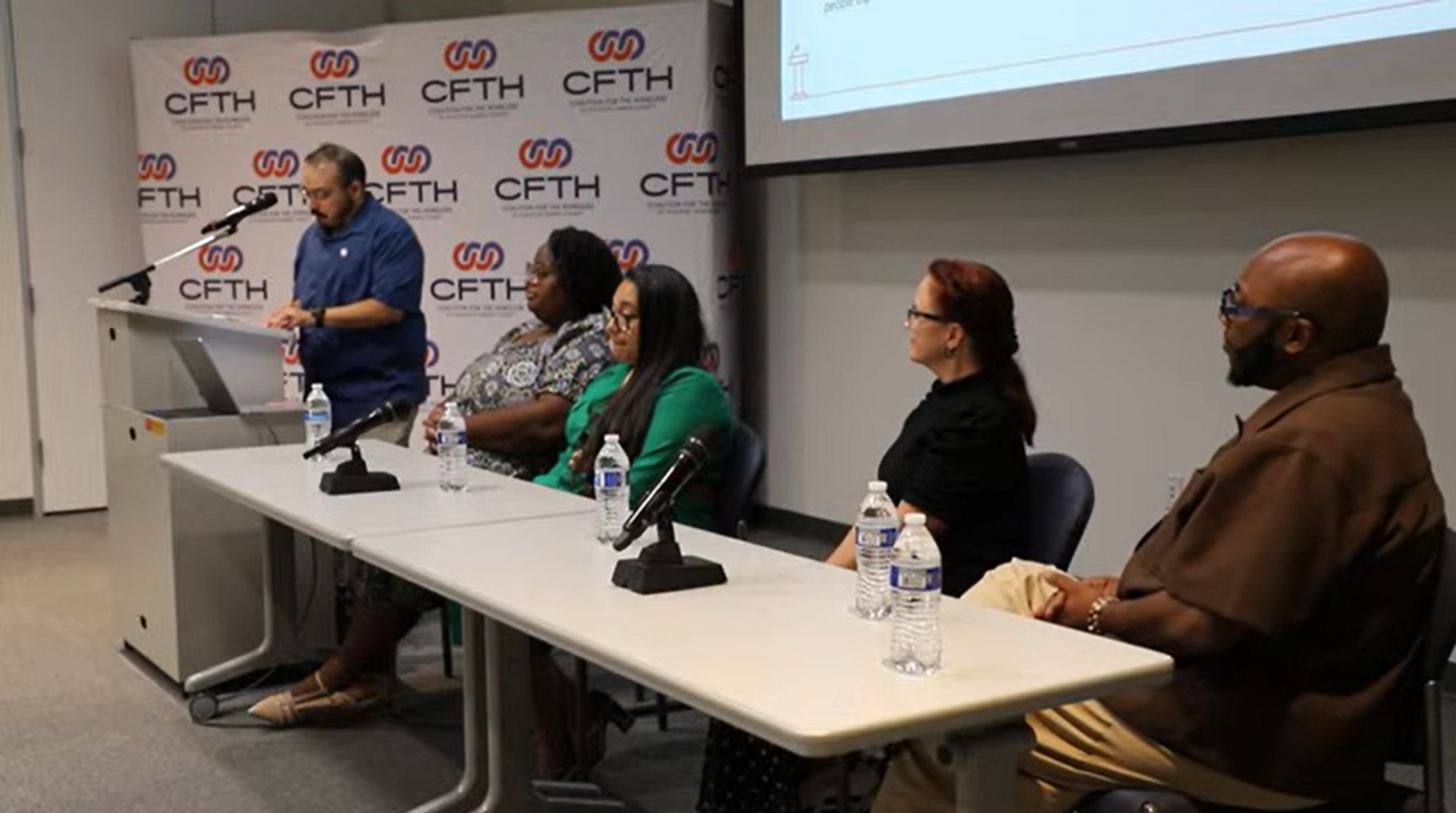
But as speakers emphasized during CFTH Presents: The PIT Count — Behind the Numbers, no single number can fully explain homelessness, or the work required to address it.
Hosted by the Coalition for the Homeless of Houston/Harris County (CFTH), the discussion brought together leaders from outreach, data systems, and public health to explore how Houston measures homelessness, why the PIT Count matters, and how year-round data helps guide the region’s homelessness response system.
What the PIT Count Measures — and What It Doesn’t
“The PIT Count is one important view of homelessness, but not the entire view,” said Renee Cavazos, Vice President of the Homeless Response System at CFTH.
The PIT Count captures sheltered and unsheltered homelessness on a designated night using a federally required methodology. But speakers stressed that homelessness is dynamic and extends beyond what can be captured in a single snapshot.
The count does not fully capture people who are doubled up with family or friends, staying temporarily in hotels, or otherwise experiencing housing instability outside the federal definition used for the count.
“A photo can be accurate and still not show everything outside the frame,” Cavazos explained.
That framing became a central theme throughout the evening: the PIT Count matters, but it is only one tool used to understand homelessness across the region.
Measuring Homelessness Across a Region the Size of Yellowstone
Houston’s Continuum of Care spans Harris, Fort Bend, and Montgomery counties — more than 3,600 square miles.
Because of the region’s size, Houston conducts the PIT Count over three days using hundreds of volunteers, outreach workers, partner agencies, and real-time coordination tools.
Toni Benson-Atkinson, Director of Program Operations at CFTH, described the extensive planning involved behind the scenes, including:
- Volunteer recruitment and training
- Geographic map assignments
- Live monitoring through mobile data systems
- Data validation and deduplication
- Coordination with shelters and outreach teams
Additional presenters also discussed the statistical analysis and methodology review process used to support the PIT Count.
“This is more than one activity,” Cavazos said. “There are a lot of things happening behind the scenes.”
Data Beyond the PIT Count
John Slimp, Senior Data Systems Engineer at CFTH, explained how the Homeless Management Information System (HMIS) helps provide a broader understanding of homelessness throughout the year.
While the PIT Count offers a snapshot, HMIS captures ongoing system activity, including:
- Shelter utilization
- Outreach engagement
- Housing enrollments
- Service delivery
- Coordinated Entry referrals
- Housing exits and returns to homelessness
Together, those data sources help answer larger questions:
- Who is entering homelessness?
- Who is exiting to housing?
- Which interventions are working?
- Where are service gaps emerging?
- How is demand changing over time?
“The PIT Count is not a perfect measure, but it is a useful tool in our toolbox,” Slimp said.
He described the PIT Count as a long-term “barometer” for understanding overall system conditions when paired with broader operational data.
Using Data to Improve the System
A recurring theme throughout the conversation was that data is not collected simply for reporting purposes — it is used to improve how the homelessness response system functions.
“We have to accept the data and act on it without cherry-picking,” Slimp said during the discussion.
Speakers described how data helps identify system pressures, measure program performance, improve coordination, and guide future planning across The Way Home Continuum of Care.
That includes balancing immediate response needs with longer-term system planning.
“You’ve heard the phrase ‘build the plane while you fly it,’” Slimp said. “Our job is to improve the plane while we fly it.”
Why Independent Methodology Matters
Dr. Ben King, epidemiologist and Clinical Assistant Professor at the University of Houston Tilman J. Fertitta Family College of Medicine, discussed the role of independent research and statistical methodology in strengthening the PIT Count process.
King explained how the PIT methodology continues evolving to improve data quality, transparency, and consistency while remaining aligned with federal standards.
“We want to give ourselves the best estimate we can,” King said.
The presentation also highlighted how Houston uses independent review, statistical modeling, and continuous methodological refinement to strengthen confidence in the data over time.
The Work Happens Year-Round
Throughout the evening, speakers repeatedly returned to one larger point:
Homelessness response cannot be solved by one organization — or measured by one number alone.
“The PIT is one day,” Cavazos said. “But individuals and families experience homelessness 365 days of the year.”
Kelly Young, President and CEO of CFTH, closed the evening by emphasizing the importance of collaboration, transparency, and long-term systems work.
“If you only tell the human story and you don’t create systems and ways to solve for the human problem, we’re never going to get anywhere,” Young said.
Looking Ahead: State of Homelessness in Houston
CFTH will release its annual State of Homelessness in Houston report in June, combining PIT Count findings with additional system indicators that help contextualize homelessness trends across the region.
The goal is to provide a fuller picture of both the challenges facing the community and the coordinated work happening year-round to address them.