Homeless Court Judge Tours Local Service Organizations to Get the Client Experience
Communications Admin • November 26, 2013

One of the projects managed by the Coalition for the Homeless is Homeless Court. Begun eight years ago, Homeless Court is an important step in the path for individuals towards a successful exit from homelessness. This program operates under the guarantee that no one appearing will go to jail as a result of the ticket(s) that bring them to Homeless Court. As long as a homeless individual has a case manager and is participating in a program with the goal of exiting homelessness, this counts as their community service. In other words, by the time they appear in court, they have worked off their ticket.
Nearly 2,000 cases were resolved through Homeless Court in 2012, and many of the infractions that bring individuals to Homeless Court include moving violations such as failing to display a valid driver’s license, and non-moving violations such as possession of an open container and even jaywalking. To most of us, these are fines we pay, and then move forward. For a homeless person who rarely has means to pay; however, these violations have the potential to build and stick with them, often leading to warrants, and preventing them from being able to find employment and/or housing. Homeless Court acknowledges that this “Catch 22″ is not beneficial to anyone, and helps homeless individuals move toward their goal of exiting homelessness.
Recently, one of the judges at Homeless Court, Judge Imelda Castillo, approached Scot More, Project Manager with the Coalition, with the request to tour local homeless service organizations, to gain a deeper understanding of the client experience, from street to housing. On this tour, Judge Castillo visited St. Joseph House, SEARCH Homeless Services, Star of Home Mission, and Harmony House clients at 1414 Congress, where she saw not only the strengths of each of these programs, but the collaboration between agencies with the goal of ending chronic homelessness.
Betty Nunnally, Senior Vice President of Programs at Star of Hope Mission, was impressed that Judge Castillo took time out of her busy schedule to better understand the people she sees in court, and felt that her dedication and desire to help them in a meaningful way was truly evident during her visit at Star of Hope. “Homeless Court gives our clients a chance to take care of past legal issues and at the same time gives them an opportunity to move forward,” said Nunnally. “We were very honored for Star of Hope to be included in Judge Castillo’s tour, and based on her investment and interest, it seems to me that she is willing to go above and beyond to help the people she sees in court.”
Another of the sites visited was SEARCH Homeless Services, and likewise, they were thrilled to be included on the tour as well. President & CEO of SEARCH, THao Costis, said, “We were pleased by the judge’s interest in wanting to learn more and understand the bigger picture of the services available, as well as the challenges that our clients face.” Costis was most excited to share her organization’s stellar case management staff, and their ability to maximize resources that are available in the community, such as Homeless Court, to the benefit of their clients.
One hope shared by both Star of Hope Mission and SEARCH Homeless Services is that Judge Castillo’s experiences on the tour will give her a greater understanding of the individuals that appear in Homeless Court, and that she will be more committed to the process – and that seems to be evident. Scot More shared that Judge Castillo’s plan is to take what she learned on this tour to other judges who sit on Homeless Court and share her experiences with them, so they too can see the full continuum of services offered in Houston, and understand just how hard it can be to exit homelessness.
More also shared that one of the goals of Homeless Court is the education which takes place. “Through Homeless Court, these individuals learn to trust the legal system. It’s an education, learning that they shouldn’t avoid their issues, and knowing what to do if they are in a similar situation in the future.” However, More feels that the most important result is the emotional benefit; the weight lifted as a result. “Most people want to do the right thing, but they don’t necessarily know how,” said More.
Homeless Court is benefitting homeless individuals not only in the obvious ways: legally and financially, but in seemingly invisible ways as well, through acknowledging their participation in a program and teaching them that systems can work for them – including the system of homeless service providers in Houston. With Judge Castillo’s participation in this tour, our system has become that much more robust and even more capable of serving our homeless neighbors.
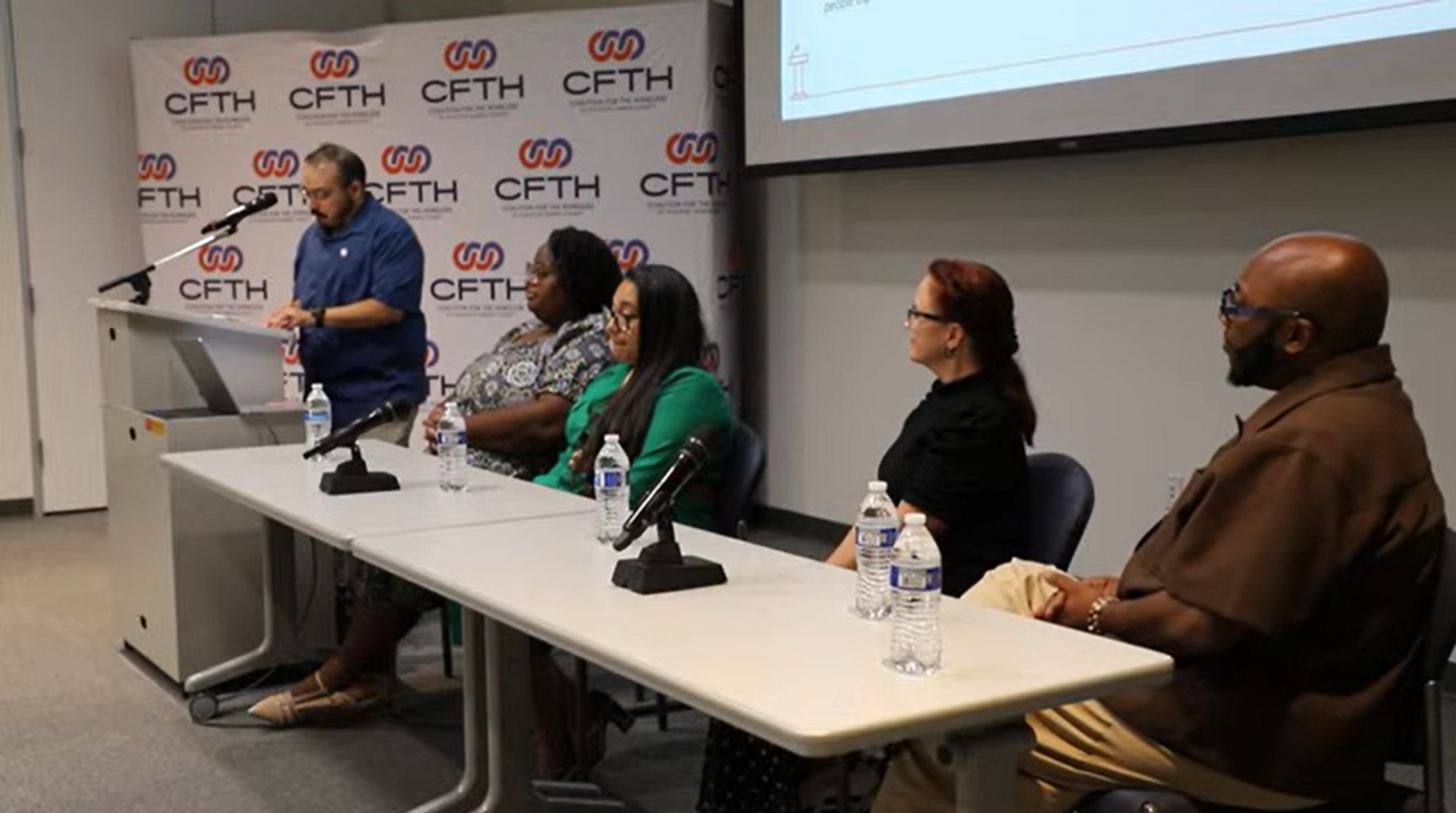
When someone experiences homelessness, the right solution is not always a long-term housing program. Sometimes a person needs help replacing an ID, reconnecting with family, finding an affordable shared home or overcoming another immediate barrier. That idea guided CFTH Presents: Building Better Pathways — Creating Faster Routes to Stability . The Coalition for the Homeless of Houston/Harris County (CFTH) hosted the discussion with leaders who oversee and carry out Rapid Resolutions across The Way Home, the Houston region’s homeless response system.

When most people think about homelessness, they picture someone sleeping outside or staying in a shelter. But homelessness often begins much earlier. A new survey from Rice University's Kinder Institute estimates that more than 140,000 adults across Harris, Fort Bend and Montgomery counties experienced temporary homelessness during the past year. Many of these individuals never slept outside. They stayed with friends or family because they had nowhere else to go, paid for motel rooms when they could, slept in their vehicles or found other temporary ways to get by. For those of us working in Houston's homeless response system, the estimate did not come as a surprise. What stands out is the scale. Our 2026 State of Homelessness report found that nearly 36,000 people interacted with The Way Home, Houston's regional homeless response system, during 2025. The Kinder estimate shows a much larger group of households struggling before they ever reach organizations like ours. Those numbers do not compete with one another. They tell the story of different points along the same continuum. By the time someone decides whether to enter a shelter or sleep outside, opportunities to prevent homelessness have often passed. The homeless response system helps people regain stability after they are in a shelter or on the street. Prevention happens months earlier, while people are still trying to hold on to their housing. Most people do not ask for help at the first sign of trouble. They work extra hours. They borrow money from family. They juggle bills. They hope next month's paycheck will solve this month's problem. Like most of us would, they try to solve the problem themselves. By the time they reach out, they often need far more help than they would have needed just a few months earlier. That is why Houston's prevention network is so important. Organizations like United Way of Greater Houston connect residents with rental assistance, utility assistance, benefits navigation and other resources that help stabilize households before they lose their housing. If you are struggling to keep up with rent, utilities or other essential expenses, do not wait until you have exhausted every option. Reaching out early gives providers more opportunities to help and gives families more options to stay housed. The Kinder research also reinforces another reality facing our region: We need more affordable housing. More than 140,000 adults experienced temporary homelessness in a single year because too many households live one unexpected expense away from losing their housing. That number points to a much larger population searching for homes they can afford long before they need homeless services. Houston's homeless response system continues to produce strong outcomes. More than 2,100 households moved into permanent housing during 2025, and 85% of those who exited homelessness two years ago remain housed today. At the same time, more than 7,100 people slept in shelters or on the street for the first time in 2025. Those numbers show that while our homeless response system continues to help thousands of people regain stability, new households continue to enter homelessness every day. The Kinder research gives Houston something we have not had before: a clearer picture of the households struggling before homelessness becomes visible. The Way Home will always play a critical role in helping people regain stability, but we also need to help more people before they ever need those services. That means strengthening prevention programs, expanding affordable housing and making it easier for people to ask for help early. Houston has repeatedly shown that when our community understands a challenge, it comes together to solve it. This research gives us a better understanding of where the next challenge begins.

Extreme Heat Is America's Deadliest Weather Hazard. Find Trusted Resources to Stay Safe and Help Others.