Press Release: Coalition for the Homeless of Houston/Harris County Awards $1.6M from Bezos Day 1 Families Fund Grant

Fryda Ochoa • December 19, 2023

Three nonprofits receive grants to address family homelessness in Houston region.

The Coalition for the Homeless of Houston/Harris County (CFTH), the lead agency to The Way Home Continuum of Care, today announced an approximately $1.6 million investment in Houston’s ongoing work to address family homelessness with grants to three key local partners: The Beacon (~$323,000); Bread of Life, Inc. (~$892,000); and Wesley Community Center (~$426,000).


The funds come from a larger $5 million grant to CFTH from the Bezos Day 1 Families Fund, announced in November 2022. Launched in 2018, the Day 1 Families Fund issues annual leadership awards to leading organizations on the frontlines that are employing compassionate, needle-moving work to help families move from unsheltered homelessness and shelters to permanent housing with the services they require to achieve stability.


“We are thrilled to be able to award these grants to our partners,” said Mike Nichols, President & CEO of CFTH. “Our homeless response system and partners have been focused for more than a decade on permanent housing with supportive services as the answer to homelessness. Thanks to the Day 1 Families Fund, the awards CFTH makes to these three partners will drive innovation and accelerate connection to services for families experiencing homelessness. However, it is still crucial that local governments step up to provide public funding. Private philanthropy alone can’t solve homelessness.”


A committee of CFTH staff selected The Beacon; Bread of Life, Inc.; and Wesley Community Center because of the sustainability of their programs and their focus on supportive services that keep families housed over the long term. Project funds will be used to assist families currently experiencing homelessness – unsheltered or sheltered – to help them regain housing through diversion, an employment pathway program, and/or social enterprise.


With the grant, The Beacon will be working to engage families with minor children who are experiencing unsheltered or sheltered homelessness or are at imminent risk of homelessness. Their work will be focused on providing intensive case management and involving families in exploratory conversations to identify realistic options to regain housing. In addition, other supportive services will be available including legal aid and help with obtaining state-issued IDs to ensure access to housing and employment.


During the 12-month grant period, The Beacon anticipates serving 96 families with minor children and successfully preventing 48 of those families from further falling into homelessness. This work will be accomplished with the addition of a diversion specialist and resource support specialist made possible by this grant. These new positions will work closely with the existing frontline staff and legal team at The Beacon to ensure that each family’s needs are understood and addressed.


“The Beacon is so honored to be recognized as an agency doing compassionate, needle-moving work in our community with this generous grant award from the Bezos Day 1 Families Fund,” said Becky Landes, Chief Executive Officer of The Beacon. “We are poised to play an integral role in helping families regain safe, stable housing, and achieve well-being through carefully planned and executed diversion services. While this work will be brand new for The Beacon, we know that many families with minor children are already reaching out to us because of our well-known reputation for helping people in crisis. All too often, these are families newly homeless or on the brink of becoming homeless. Our program staff have learned to triage these instances, but this funding will truly galvanize our ability to keep families stably housed.”


The Bread of Life, Inc. Academy provides vocational training and pathways to employment for adults who have experienced hardship and are seeking to transform their lives through education and career development. In addition to vocational instruction, life skills, and career coaching, the academy provides wraparound services, helping address unmet needs that may prevent students from completing the program and moving toward new opportunities. At the conclusion of their training, students will be eligible for certification as a phlebotomist, community health worker, or IT associate, propelling their income potential forward and providing a steppingstone to financial security for their families.


With this funding, Bread of Life, Inc. plans to start a new initiative called Project H.O.P.E., to bridge the gaps in mental health services and address the urgent needs of students in The Academy requiring healing, outreach, prevention, and education.

“Individuals who have experienced foster care or incarceration — and those who are from marginalized communities — are often more likely to experience mental health symptoms and tend to be less likely to get appropriate care and treatment,” said Dr. Ryan Harris, Vice President of Behavioral Health Services at Bread of Life, Inc. “We are grateful unmet mental health needs will no longer be a barrier for students in The Academy who are seeking to transform their lives. This funding will provide needed therapeutic interventions by licensed professionals to promote health and well-being for our students.”


Wesley Community Center will help community members who are leaving homelessness train for new careers while receiving wraparound services such as childcare, transportation assistance, income assistance, and mental health services. Wesley's work has always centered around helping the whole person, and these additional resources will make it easier for clients to reach their goals by removing the stumbling blocks that sometimes prevent success.


“This grant will help provide transformative services at Wesley Community Center,” said Amy Corron, President & CEO of Wesley Community Center. “We are so grateful for this opportunity, allowing us to provide families with employment and supportive services, and, for the first time, paying stipends to help offset the opportunity cost of spending weeks and months in training. This is a game-changing opportunity for many families who can’t take time off work to train for a better job. We are excited to pilot this expansion of our services.”


The grant-funded programs will run through Nov. 30, 2024. Anyone experiencing homelessness who is interested in receiving services should contact the Coordinated Access email inbox run by CFTH at ca@homelesshouston.org.

By Sara Hart June 12, 2026
Houston, Texas (June 12, 2026) — The Coalition for the Homeless of Houston/Harris County (CFTH) today released the results of the 2026 Point-in-Time Count & Survey as part of the inaugural State of Homelessness in Houston report, a regional effort that combines PIT Count data with additional system indicators to provide a broader understanding of homelessness and system response across Harris, Fort Bend, and Montgomery counties. The report found 3,321 people experiencing homelessness on a single night in February 2026, reflecting relative stability compared to the 2025 Point-in-Time Count of 3,325. At the same time, the data highlights continued challenges related to unsheltered homelessness, economic and housing pressures, and the ongoing need for coordinated regional investment in homeless response and prevention efforts. This year’s report expands beyond the annual Point-in-Time (PIT) Count to include additional indicators generated through the Homeless Management Information System (HMIS) and HUD System Performance Measures (SPMs). Together, these measures provide additional context about year-round interactions with the homeless response system, housing stability outcomes, and inflow into homelessness over time. "The Point-in-Time Count is like a photograph," said Renee Cavazos-Benavides, vice president of the homeless response system at CFTH . "It captures an important moment, but there is always more happening outside the frame. That's why this year's report includes additional indicators that help us understand how people move into homelessness, how they move back into housing, and where we need to focus our efforts as a community." Key findings from the report include: 3,321 people experiencing homelessness during the February 2026 PIT Count 35,988 unique clients served through the homeless response system, The Way Home, during calendar year 2025 2,135 households housed by partners of The Way Home during calendar year 2025 7,110 people entering homelessness for the first time during federal FY25 85% of people who exited homelessness remained stably housed over a two-year period The PIT Count found 2,051 sheltered individuals and 1,270 unsheltered individuals across Harris, Fort Bend, and Montgomery counties. "The additional data shows our system is doing a great job maintaining our progress, in spite of additional economic stressors and pandemic funding having been exhausted,” said Kelly Young, president and CEO of CFTH . “Further progress will depend not only on additional investments in housing and services but also on our ability to expand new interventions to resolve homelessness more quickly." More than half of unsheltered individuals identified during the PIT Count had a matching HMIS record, reflecting ongoing engagement between outreach teams and people experiencing unsheltered homelessness. The findings underscore the continued need for outreach, additional pathways indoors, and sustained local investment to maintain system stability and respond to changing community needs. “The Point-in-Time Count gives our community a chance to pause and check in with people who may not yet be housed, sheltered, or consistently connected to services,” said Dr. Ben King, clinical assistant professor at the University of Houston Tilman J. Fertitta Family College of Medicine . “It helps us capture information that does not always show up in routine system data — including where people are staying, what barriers they are facing, and what they identify as the causes of their homelessness. Used alongside HMIS data, program performance measures, and community input, the PIT Count remains an important tool to answer questions we wouldn't get to ask otherwise." The annual PIT Count is required by the U.S. Department of Housing and Urban Development (HUD) and helps communities measure trends in homelessness over time. However, the PIT Count does not represent the total number of people who experience homelessness throughout the year. The 2026 State of Homelessness in Houston report combines PIT Count data with other key indicators to provide a more complete picture of homelessness across the region. Behind every number is a person, and a better understanding of homelessness helps communities respond more effectively. "The results remind us that homelessness is one of the most complex challenges facing our city. This is why the 419 Emancipation resource living facility is so important. We will continue working with stakeholders to move people off the streets and provide them with assistance, with the goal of reducing homelessness throughout our community and our neighborhoods," said Mayor John Whitmire. “I’m so proud that Harris County has reduced homelessness by more than 16% between 2018 and 2026, even when most other communities have seen homelessness skyrocket. We’re tackling the issue from both ends: we’re investing in programs to prevent poverty and promote economic mobility, and we’re also prioritizing safe and stable housing for those experiencing homelessness. Our community is only as successful as our most vulnerable residents, and I want to thank the Coalition for the Homeless, The Way Home, and all of our other local partners who have helped turn Harris County into a national model for reducing homelessness,” said Harris County Judge Lina Hidalgo. "The 2026 Point-in-Time Count confirms that our region has remained stable while homelessness has increased in many other parts of the country. However, stability is not enough when over a thousand of our neighbors are still sleeping outside. I’m grateful to the Coalition for the Homeless, The Way Home, outreach teams, law enforcement, service providers, and volunteers for showing that a coordinated local approach can help move people from crisis toward housing,” said Harris County Precinct 2 Commissioner Adrian Garcia . “As a former street cop and sheriff, I know we do not solve homelessness by simply moving people from one place to another. We solve it by treating people with dignity, connecting them to services, and creating real pathways to housing. I remain committed to working with our partners to prevent homelessness, support our veterans and most vulnerable residents, and make homelessness rare, brief, and nonrecurring in Harris County." “Harris County’s stability in the Point‑in‑Time Count stands out against the sharp increase in homelessness seen nationwide since the pandemic,” said Harris County Precinct 4 Commissioner Lesley Briones . “These results reflect years of continued investment in strengthening partnerships and expanding critical services, including two new emergency shelters for survivors of domestic violence. We know there is much more work ahead, and I remain committed to working alongside our partners to prevent and ultimately end homelessness in our community.” “Even with limited new funding and few new programs launched during this reporting period, Houston has remained relatively stable. What this latest data underscores is the need to continue investing in service-connected solutions like 419 Emancipation,” said Mike Nichols, Director of the City of Houston Housing and Community Development Department . “Now that 419 is operational, we are optimistic this triage, transition, and treatment model will help connect more individuals to care, services, and clear pathways toward stability. Behind every number is a real person, and our goal is to ensure more Houstonians are connected to the right support and a stronger path forward.” The full report and methodology appendix are available online here. The executive summary is available online here. The State of Homelessness report is available online here. For more information about the PIT Count and The Way Home homeless response system, visit www.cfthhouston.org. For more information and for results of previous years’ counts, please click here . For photos and B roll of volunteers conducting this year’s PIT Count, click here . ### The Coalition for the Homeless of Houston/Harris County (CFTH) is the backbone of Houston’s solutions to homelessness. It’s a nonprofit organization that uses the power of collective impact to move people experiencing homelessness into housing solutions. Learn more at www.cfthhouston.org . The Way Home is the homeless response system for Houston and Harris, Fort Bend, and Montgomery counties. It’s a public-private partnership — a network of dozens of homeless service providers and other government, philanthropic, and business partners. The Coalition for the Homeless of Houston/Harris County (CFTH), a 501c3, is the designated coordinator of The Way Home.
By Sara Hart May 15, 2026
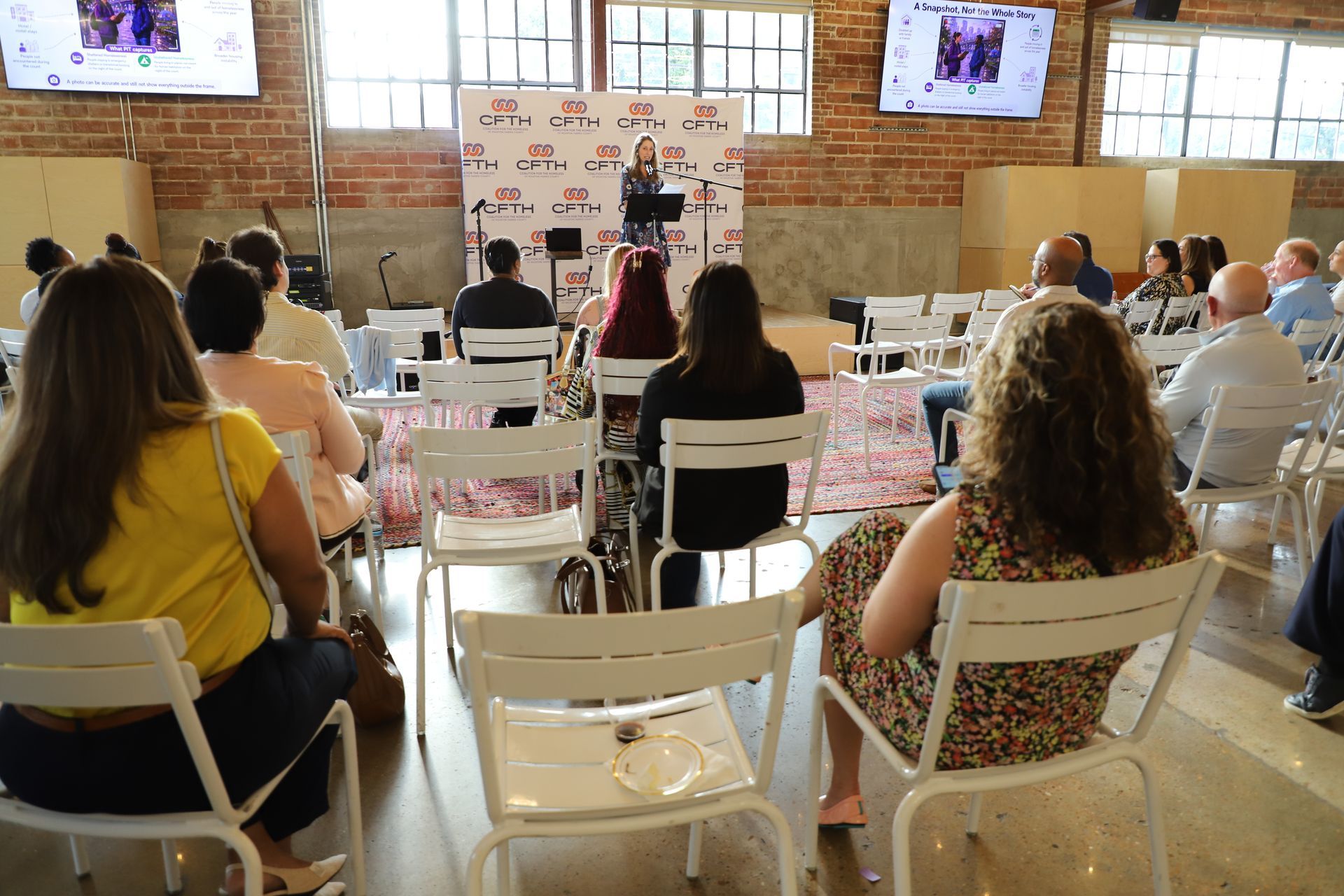
Every year, Houston’s Point-in-Time (PIT) Count helps provide a snapshot of homelessness across the region. But as speakers emphasized during CFTH Presents: The PIT Count — Behind the Numbers , no single number can fully explain homelessness, or the work required to address it. Hosted by the Coalition for the Homeless of Houston/Harris County (CFTH), the discussion brought together leaders from outreach, data systems, and public health to explore how Houston measures homelessness, why the PIT Count matters, and how year-round data helps guide the region’s homelessness response system.
By Catherine Villarreal February 24, 2026
Houston, Texas (February 24, 2026) – This week, the nonprofit Coalition for the Homeless of Houston/Harris County (CFTH) is leading the annual Point-in-Time Homeless Count & Survey (“PIT Count”) to determine the number of people experiencing homelessness across Houston and throughout Harris, Fort Bend, and Montgomery counties. “We may see a slight uptick in the number this year, but we have a plan,” said Kelly Young, President & CEO of CFTH. “With the support of the City of Houston, Harris County, and private funders, we have been piloting new interventions to shorten the length of time people in our region experience homelessness. With adequate funding, we look forward to expanding those interventions to help people regain lives of self-determination.” CFTH coordinates the Houston region’s public-private homeless response system, The Way Home . Through this collaboration, The Way Home partners have successfully housed over 36,000 people since 2012. CFTH will release the results of Houston’s 2026 PIT Count in the summer, following independent verification by an epidemiologist. These findings will provide insight into how factors such as increases in the cost of living and the end of federal pandemic relief funding have impacted homelessness in our region. More information about the 2026 Point-in-Time Homeless Count & Survey The PIT Count offers a snapshot of how many people are experiencing homelessness in our region on a single night. This year, the “night of record” is Monday, Feb. 23. CFTH determines the number of people staying in shelters on that night by pulling records electronically from the Homeless Management Information System (HMIS) . The unsheltered count will be conducted on the following days, from Tuesday, Feb. 24 to Thursday, Feb. 26. More than 400 volunteers and staff of local nonprofit service provider partners will canvass the three-county region to survey people living unsheltered, using an app on their mobile devices. Results from the 2026 PIT Count will help gauge the progress of The Way Home’s ongoing collaborative efforts. It will also help CFTH and partner homeless outreach teams understand geographic shifts and target their outreach throughout the year. The PIT Count illuminates specific programmatic gaps and provides additional information needed to allocate resources most efficiently. The PIT Count is a requirement of the U.S. Department of Housing & Urban Development (HUD) for the annual Continuum of Care (CoC) funding process. HUD furnishes the majority of funding for programs that provide housing and supportive services to people experiencing homelessness in the region. In 2024, HUD granted more than $71 million to the Houston area.
Show More